Introduction: A City of Opportunity and Overcrowding
In the spring of 1847, thousands of exhausted Irish immigrants stepped off crowded ships at New York Harbor after weeks crossing the Atlantic. Many had fled the Great Famine, leaving behind homes, farms, and loved ones in search of survival rather than prosperity. Instead of finding the America they had imagined, they entered neighborhoods where entire families rented a single room, sewage flowed through dirt streets, and disease spread faster than hope.
Within only a few decades, New York City transformed from a relatively small commercial port into one of the world’s fastest-growing urban centers. Between 1820 and 1860, more than five million immigrants arrived in the United States, and New York became the nation’s primary gateway. Historians estimate that by 1860, nearly half of New York City’s residents had been born overseas, while many others were the American-born children of immigrants. This extraordinary population growth reshaped the city forever—but it also created conditions that gave birth to America’s first large-scale urban slums.
The story of New York’s first slums is not simply one of immigration. Poverty had existed long before mass migration, but the arrival of hundreds of thousands of newcomers collided with inadequate housing, speculative real estate, economic instability, weak public infrastructure, and limited government oversight. The result was a humanitarian crisis that would influence housing policy, public health, and social reform for generations.
To understand the origins of poverty and homelessness in New York City, we must travel back to the city’s earliest decades, when immigration and urban growth transformed opportunity into overcrowding and created neighborhoods whose names—particularly Five Points—would become synonymous with urban poverty around the world.
Before Mass Immigration: Poverty in a Growing Port City (1790–1820)
At the beginning of the nineteenth century, New York was already becoming America’s commercial capital. Ships crowded the East River docks carrying goods from Europe, the Caribbean, and the expanding American frontier. Merchants accumulated enormous wealth, while dockworkers, laborers, artisans, and servants formed the city’s growing working class.
Yet poverty remained highly visible.
Unlike later decades, homelessness was relatively limited because the city’s population remained manageable. Poor residents often relied on relatives, churches, or public almshouses—institutions established to house people unable to support themselves. Almshouses offered shelter but were intentionally austere. Many believed poverty resulted from personal failure rather than structural economic conditions, and public assistance was designed to discourage dependency.
Housing generally consisted of modest wooden homes or small brick buildings. Although crowded by modern standards, these neighborhoods had not yet reached the crushing density that would define later immigrant districts.
Employment was often seasonal. Dockworkers could earn wages one week and find themselves unemployed the next. Economic downturns quickly pushed working families toward debt, hunger, and reliance on charitable aid.
This early period established an important pattern that would repeat throughout New York’s history: rapid economic growth produced immense wealth while leaving many laborers vulnerable to poverty whenever commerce slowed.
Why this era mattered: By the early nineteenth century, New York already possessed economic inequality and limited poor relief. These conditions would become far more severe once immigration accelerated dramatically.
The First Great Wave of Immigration (1820–1845)
By the early 1820s, New York Harbor had become America’s busiest point of entry.
Immigrants arrived from Ireland, Germany, England, Scotland, and other parts of Europe. Some came seeking opportunity. Others fled political unrest, religious discrimination, crop failures, or limited economic prospects.
The city’s population exploded.
In 1820, New York contained approximately 123,000 residents. By 1840, that number had grown to more than 312,000, and growth continued at an astonishing pace.
Landlords quickly recognized an opportunity.
Rather than constructing quality housing, many divided existing homes into multiple rental units. Single-family houses became crowded boarding houses. Basements, attics, and former workshops were rented to entire families.
As demand increased, speculative developers built inexpensive multi-family buildings with little concern for sanitation or ventilation.
These early tenements represented the beginning of New York’s slum housing.
Most lacked indoor plumbing.
Water often came from shared pumps.
Human waste accumulated in backyard privies.
Garbage remained in streets for days or weeks.
Livestock wandered among pedestrians.
During summer months, the smell of refuse, animal waste, and stagnant water filled entire neighborhoods.
Despite these conditions, rents remained high because housing shortages left immigrants with few alternatives.
Most newcomers accepted overcrowding because they viewed it as temporary. Many hoped that steady employment would allow them to move into better neighborhoods.
For thousands, however, poverty proved far more persistent than expected.
Why this era mattered: Immigration increased faster than housing construction, laying the foundation for chronic overcrowding and the emergence of densely populated immigrant neighborhoods.
The Irish Famine and the Birth of America’s First Slums (1845–1855)
The next major shift occurred when catastrophe struck Ireland.
Beginning in 1845, potato blight destroyed successive harvests, leading to the Great Irish Famine. More than one million people died, while another million emigrated.
New York became their principal destination.
Ships carrying famine refugees arrived almost daily.
Many passengers had exhausted their savings simply reaching America. They arrived hungry, sick, and unable to afford decent housing.
Unable to purchase homes, Irish immigrants concentrated in the city’s cheapest districts, particularly the notorious neighborhood known as Five Points.
Located on former marshland in lower Manhattan, Five Points had poor drainage even before dense settlement. Streets frequently became muddy, while standing water created ideal conditions for disease.
Visitors described scenes almost beyond belief.
Entire families occupied single rooms.
Boarders slept in shifts because there was insufficient floor space.
Cellars flooded during heavy rain.
Broken windows remained unrepaired.
Ventilation was almost nonexistent.
Animals, children, and adults shared cramped courtyards overflowing with waste.
The New York press often portrayed Five Points as a place of vice and criminality. Newspapers emphasized gangs, gambling, prostitution, and drunkenness. While crime certainly existed, such accounts frequently ignored the overwhelming structural causes behind neighborhood poverty.
For most residents, daily life centered not around crime but survival.
Men searched for work on docks or construction projects.
Women labored as domestic servants or seamstresses.
Children sold newspapers, collected scrap materials, or worked in factories.
Employment remained unstable, wages low, and housing costs disproportionately high.
Disease flourished.
Cholera outbreaks in 1832 and 1849 struck overcrowded neighborhoods particularly hard. Physicians increasingly recognized links between sanitation and public health, although scientific understanding remained limited.
One observer wrote that many buildings “seemed scarcely fit for human habitation.”
His description understated reality.
Why this era mattered: The Irish famine transformed overcrowded neighborhoods into internationally recognized urban slums, forcing reformers and public officials to confront poverty on an unprecedented scale.
German Immigration and Expanding Working-Class Neighborhoods (1850s–1860s)
While Irish immigration continued, another major migration reshaped New York.
Political revolutions across Europe in 1848, combined with economic hardship, encouraged large numbers of Germans to emigrate.
Many settled in neighborhoods east of the Bowery, creating vibrant communities filled with churches, breweries, newspapers, and cultural organizations.
German immigrants generally arrived with somewhat higher literacy rates and occupational skills than many famine refugees. Skilled craftsmen found employment in furniture making, printing, brewing, and manufacturing.
Yet even these advantages could not overcome New York’s severe housing shortage.
Working-class districts continued growing denser.
Rows of narrow brick tenements stretched across Manhattan.
Buildings frequently covered nearly every square foot of their lots, leaving little sunlight or fresh air.
Rear houses stood hidden behind front buildings, accessible only through narrow passageways.
Fire hazards multiplied.
Tuberculosis spread rapidly.
Infant mortality remained devastatingly high.
Despite these hardships, immigrant neighborhoods developed remarkable resilience.
Mutual aid societies provided financial assistance.
Churches distributed food.
Ethnic newspapers shared employment opportunities.
Neighbors cared for sick families.
Community organizations often filled roles that city government neglected.
Why this era mattered: Immigration diversified New York while demonstrating both the strengths of immigrant communities and the severe limitations of private charity alone.
Tenement Life: Poverty Behind Brick Walls
By the middle of the nineteenth century, the word tenement had become closely associated with urban poverty.
Originally, a tenement simply referred to any rented building.
Over time, however, the term came to describe overcrowded apartment houses occupied primarily by low-income families.
A typical room measured only a few hundred square feet.
Families of six, eight, or even ten people might eat, sleep, cook, and work within the same space.
Many apartments lacked windows opening directly outdoors.
Ventilation depended on open doors or narrow air shafts that admitted little fresh air.
Running water rarely existed inside apartments.
Residents shared outdoor privies with dozens of neighbors.
Laundry hung between buildings.
Coal smoke darkened walls.
Street vendors shouted throughout the day.
Horse-drawn wagons rattled over uneven roads.
Factory whistles echoed across lower Manhattan.
The smell combined coal smoke, horse manure, garbage, smokehouses, breweries, and overflowing privies into an unforgettable mixture described by numerous nineteenth-century visitors.
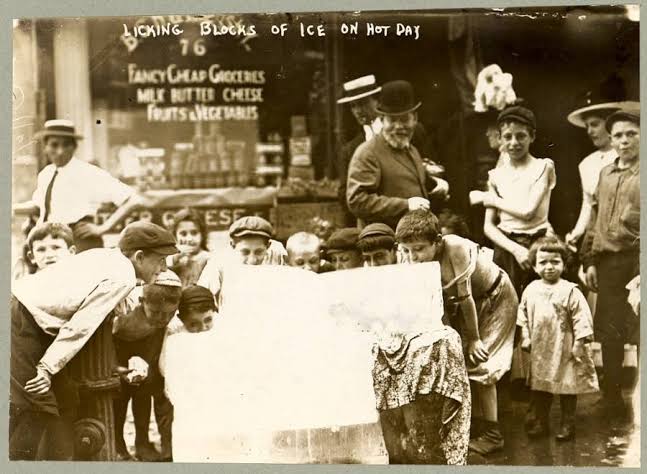
For immigrant children, streets became playgrounds, workplaces, and classrooms alike.
Many attended school only irregularly because families depended upon their earnings.
Others entered factories before reaching adolescence.
Poverty shaped nearly every aspect of childhood.
Reformers Begin Documenting the Crisis (1860s–1890s)
Following the Civil War, concern about urban poverty intensified.
Religious organizations expanded charitable missions.
Settlement houses began offering education, childcare, and medical assistance.
Municipal officials slowly accepted greater responsibility for sanitation.
One of the most influential figures emerged during the late nineteenth century: journalist and photographer Jacob Riis.
Using flash photography, Riis documented tenement interiors rarely seen by middle-class audiences.
His landmark 1890 book, How the Other Half Lives, shocked readers with images of overcrowded apartments, exhausted workers, and neglected children.
Riis argued that poor housing—not merely individual behavior—contributed directly to disease, crime, and suffering.
Although some of his interpretations reflected the biases of his era, his photographs fundamentally changed public understanding of urban poverty.
Around the same time, reformers pushed for stronger housing regulations.
Investigations revealed shocking death rates among children living in tenements.
Public health experts increasingly connected clean water, ventilation, and waste removal with lower mortality.
Pressure for reform grew.
The Tenement House Act and a New Direction (1879–1901)
Government intervention remained gradual.
The Tenement House Act of 1879 required many new buildings to include windows opening onto narrow air shafts.
Although intended to improve ventilation, developers exploited loopholes.
The resulting “dumbbell tenements” technically satisfied legal requirements while remaining overcrowded and unhealthy.
The next major shift occurred with the Tenement House Act of 1901.
This law introduced significantly stricter building standards.
Requirements included improved ventilation, larger courtyards, indoor toilets in many buildings, fire safety measures, and stronger enforcement.
Conditions did not improve overnight.
Thousands continued living in older buildings.
Yet the legislation marked a turning point in recognizing safe housing as a matter of public concern rather than purely private business.
Why this era mattered: Housing reform demonstrated that poverty could not be addressed solely through charity; urban planning and government regulation also shaped living conditions.
Lasting Impact: How Immigration Reshaped Modern New York
The first immigrant slums permanently transformed New York City.
Many neighborhoods once dismissed as hopeless eventually evolved into thriving communities.
The Lower East Side became a center of Jewish culture.
Little Italy emerged nearby.
Chinatown expanded during subsequent decades.
Harlem later became one of the world’s most important centers of African American culture.
The descendants of immigrants who once lived in overcrowded tenements became business owners, teachers, artists, public officials, and community leaders.
At the same time, many of the structural issues first visible in nineteenth-century slums remain recognizable today.
Affordable housing shortages continue to challenge New York.
Overcrowding still affects some immigrant communities.
Public debates persist regarding housing affordability, homelessness, public assistance, zoning, and urban development.
Modern policymakers continue confronting questions first raised nearly two centuries ago: How can rapidly growing cities provide affordable housing? What responsibilities belong to government, charities, employers, and private landlords? And how can cities welcome newcomers without allowing overcrowding to undermine public health?
Key Historical Takeaways
- Rapid immigration alone did not create New York’s first slums; the combination of explosive population growth, inadequate housing construction, speculative landlords, and limited government oversight did.
- The Great Irish Famine accelerated immigration dramatically, concentrating thousands of impoverished newcomers in neighborhoods such as Five Points.
- Overcrowded tenements contributed to disease, high infant mortality, and persistent poverty, revealing the close relationship between housing and public health.
- Immigrant communities built churches, mutual aid societies, schools, and charitable organizations that provided vital support long before government welfare systems expanded.
- Reformers including Jacob Riis helped expose tenement conditions, influencing housing laws and changing public attitudes toward urban poverty.
- The housing reforms of the late nineteenth and early twentieth centuries established principles that continue to influence building codes and urban policy today.
Conclusion: The Legacy of New York’s First Slums
The story of New York City’s first slums is often remembered through dramatic images of crowded tenements and notorious streets, but those images tell only part of the story. Beneath them were families who crossed oceans in search of safety, workers who built the city’s railroads, docks, factories, and neighborhoods, and children whose lives unfolded in conditions shaped by forces far beyond their control.
Immigration did not create poverty on its own. Rather, it exposed the consequences of a city unprepared for extraordinary growth. Housing shortages, uneven economic opportunity, weak sanitation, and limited public oversight turned hope into hardship for hundreds of thousands of newcomers. Yet those same communities also demonstrated remarkable resilience, forming networks of mutual aid, preserving cultural traditions, and laying the foundations for neighborhoods that would become central to New York City’s identity.
Understanding how immigration created New York’s first slums reminds us that the history of poverty and homelessness is not simply a record of deprivation. It is also a history of adaptation, reform, and the ongoing struggle to ensure that a city built by generations of newcomers can provide safe housing and opportunity for all who call it home.